Launch of a Major Project to Develop and Publish a Status Report on the State of Access to Justice in Canada / Lancement d’un grand projet visant à rédiger et à publier un rapport d’étape sur l’état de l’accès à la justice au Canada

As work to improve access to justice in civil and family matters continues to gain momentum across Canada, the Action Committee on Access to Justice in Civil and Family Matters is pleased to announce the launch of a major project to develop and publish a Status Report on the State of Access to Justice in Canada. The project will be carried out by the Canadian Forum on Civil Justice.

The Action Committee was convened in 2008 by the Rt. Honourable Beverley McLachlin, Chief Justice of Canada, in order to develop consensus and priorities around improving access to civil and family justice in Canada, while also encouraging cooperation and collaboration between all stakeholders in the justice system. In 2013, the Action Committee published Access to Civil & Family Justice: A Roadmap for Change, which contains 9 Justice Development Goals that, if accomplished, will help to address the large and growing access to justice gap in Canada.

The first step in the project is to do an in-depth survey of organizations working to improve access to justice. The survey instrument, which is now available, is built around the Justice Development Goals. The survey can be completed on-line by any organization, institution or body that defines itself as engaging in activities designed to improve access to justice.

The next step will be to compile and publish the survey results. This will occur in time for the Action Committee’s next annual meeting in March of 2017.

I urge every organization working to improve access to civil and family justice to complete and return the survey and to encourage other organizations in your network to do the same. The value of the status report depends on the response level and I hope that you will support this ground-breaking project.

~ The Hon. Thomas Cromwell

This article was originally published here:
http://www.justicedevelopmentgoals.ca/blog/2016/11/23/survey


Alors que les efforts pour améliorer l’accès à la justice en matière civile et familiale se multiplient partout au Canada, le Comité d’action sur l’accès à la justice en matière civile et familiale est heureux d’annoncer le lancement d’un grand projet visant à rédiger et à publier un rapport d’étape sur l’état de l’accès à la justice au Canada. Le projet sera mené par le Forum canadien sur la justice civile.

Le Comité d’action a été formé en 2008 par la très honorable Beverley McLachlin, juge en chef du Canada, pour établir un consensus et des priorités concernant l’amélioration de l’accès à la justice en matière civile et familiale au Canada, tout en encourageant également la coopération et la collaboration entre tous les intervenants du système de justice. En 2013, le Comité d’action a publié le document intitulé L’accès à la justice en matière civile et familiale : Une feuille de route pour le changement, lequel contient 9 objectifs de développement en matière de justice qui, s’ils sont atteints, aideront à combler l’écart important et grandissant en ce qui concerne l’accès à la justice au Canada.

La première étape du projet consiste à mener un sondage approfondi auprès des organisations qui travaillent à l’amélioration de l’accès à la justice. Le questionnaire du sondage, qui est maintenant accessible, repose sur les objectifs de développement en matière de justice. Le sondage peut être rempli en ligne par toute organisation, toute institution ou tout organisme qui se définit comme un participant à des activités conçues pour améliorer l’accès à la justice.

L’étape suivante consistera à compiler et à publier les résultats du sondage avant la prochaine réunion annuelle du Comité d’action qui aura lieu au mois de mars 2017.

J’incite fortement toutes les organisations qui travaillent à l’amélioration de l’accès à la justice en matière civile et familiale ainsi que les autres organisations faisant partie de leur réseau à répondre au sondage. La valeur du rapport d’étape dépend du taux de réponse au sondage et j’espère que vous appuierez ce projet novateur.

~ L’hon Thomas Cromwell

Cet article a été publié pour la première fois sur:
http://www.justicedevelopmentgoals.ca/blog/2016/11/23/sondage
Public Perceptions of Access to Justice in Ontario

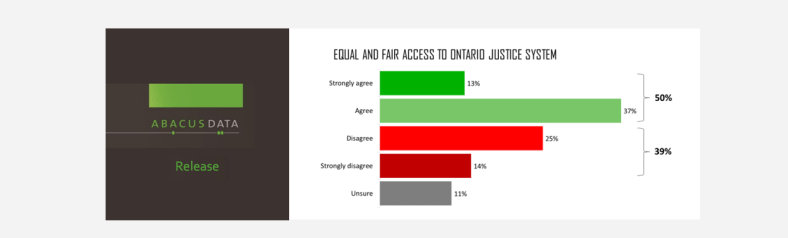
What do Ontarians think of their justice system? In August 2016, The Action Group on Access to Justice (TAG), in conjunction with Abacus Data, polled 1,500 Ontarians online to find out about their perceptions of Ontario’s justice system.

Some of the poll’s key findings include:

  • 40 per cent of Ontarians do not believe that they have fair and equal access to the justice system
  • Of those who have needed legal help, 46 per cent sought advice from lawyers and almost one third (32 per cent) turned to friends or family for advice
  • Only 26 per cent sought information via the internet

The complete report, Public Perceptions on Access to Justice, is available here.

An International Review of Early Neutral Evaluation Programs and their use in Family Law Disputes in Alberta

The Canadian Research Institute for Law and the Family has just released a report entitled: “An International Review of Early Neutral Evaluation Programs and their Use in Family Law Disputes in Alberta.”

Generally speaking, early neutral evaluation programs are court-based programs that require the parties to a dispute to attend a neutral third party evaluator early on the life of a lawsuit. At these hearings, the parties present their positions in the case and receive the feedback of the evaluator on the merits of those positions and the likely result of the lawsuit if it went to trial. The evaluator may assist the parties in settling all or some of the issues in dispute. However even when a full settlement is not reached, the hearing provides a useful reality check for litigants, helps to clarify the issues in dispute and prepares the parties for future judicial and extrajudicial dispute resolution processes.

Research conducted by The Canadian Research Institute for Law and the Family shows that these hearings result in high satisfaction rates for litigants, lawyers and evaluators. They promote settlement and the taking of positions supported by the law, and save litigants time, money and emotional stress as a result. They also provide savings to the justice system by reducing the number of contested applications and reducing the number and length of trials.

Based on these findings, the Canadian Research Institute for Law and the Family proposes that a working group be established to explore the implementation of a pilot early neutral evaluation project in Alberta. The Institute makes a variety of recommendations on the optimum characteristics of such a pilot project, drawn from their research, and on the issues the working group must address in its deliberations. In their view, the proposed pilot project aligns well with the objectives and guiding principles of the Reforming the Family Justice System Initiative presently exploring means of improving the family justice system in Alberta, and may be ideally suited for adoption and evaluation as a prototype by the Initiative.
The authors of the report are Joanne Paetsch (paetsch@ucalgary.ca) and John-Paul Boyd (jp.boyd@ucalgary.ca). Please address any comments, questions or concerns you may have to them.

In addition, this report pairs nicely with the conclusions reached in the Canadian Research Institute for Law and the Family’s 2014 report, “Self-Represented Litigants in Family Law Disputes: Contrasting the Views of Alberta Family Law Lawyers and Judges of the Alberta Court of Queen’s Bench” by John-Paul Boyd and Lorne Bertrand. This earlier report concludes that self-represented litigants tend to take unreasonable positions in family law disputes which ultimately reduce the likelihood that these disputes will resolve without a trial. When cases involving self-represented litigants do reach trial, they tend to require more adjournments and take longer to resolve as a result of self-represented litigants’ unfamiliarity with the rules of court, the rules of evidence and the law that applies to their cases, and the results self-represented litigants achieve tend to be worse than the results they would have achieved had they had counsel. An early neutral evaluation program which includes an objective appraisal of the strengths and weaknesses of the parties’ positions would likely be of great assistance to these litigants.

For more information about the other projects the Institute is engaged in or developing, please visit www.crilf.ca/current_projects.htm.

Legal Aid Benchmarks

In 2014, a joint Working Group of the Canadian Bar Association (CBA) and the Association of Legal Aid Plans of Canada (ALAP) collaborated to formulate and propose national legal aid benchmarks for Canada. After much consultation and discussion, the national benchmarks have now been completed. These benchmarks are guiding principles to achieve the shared goal of a national, integrated system of public legal assistance focused on improving access to justice and meeting the needs of disadvantaged people across Canada. These 6 national legal aid benchmarks, under headings of an overall vision, scope of services, priorities for service, spectrum of service, quality of service and an integrated service delivery sector, capture current evidence about legal aid and define pathways for the future, are intended to provide a foundation for national indicators with common data measurement.

To explain these concepts further, the CBA has authored a separate report further elaborating on the rationale and potential of national benchmarks for Canada.

For more information or to provide feedback, contact equaljustice@cba.org.

—————————————————-

L’Association du barreau canadien (ABC) et l’Association des régimes d’aide juridique (ARAJ) ont collaboré pour formuler des normes nationales de services d’assistance juridique pour le Canada. Ces normes sont des principes directeurs visant l’atteinte de l’objectif commun d’un régime national et intégré de services d’assistance juridique publics axés sur l’amélioration de l’accès à la justice et sur la réponse aux besoins des personnes défavorisées au Canada. Les six normes – vision globale, portée des services, priorité des services, éventail des services, qualité des services et secteur de prestation de services intégrés – expriment des indices matériels actuels au sujet de l’assistance juridique et définissent des voies d’avenir. Elles procurent un fondement d’élaboration pour des indicateurs nationaux assortis de mesures communes de données.

Un rapport séparé de l’ABC, Un cadre national pour combler les besoins juridiques : Proposition de normes nationales de services d’assistance juridique publics, expose la raison d’être et le potentiel de ces normes nationales pour le Canada.

Pour obtenir de plus amples renseignements, veuillez communiquer avec L’ABC à justicepourtous@cba.org.

Civil Justice and Economics: A Matter of Value / Justice civile et économie : une question de valeur

The Canadian Institute for the Administration of Justice (CIAJ), in partnership with the Canadian Forum on Civil Justice (CFCJ), invite you to this year’s “Civil Justice and Economics: A Matter of Value” conference.

This conference will offer a platform for Canadian judges, practitioners and those involved in the administration of justice to discuss their work through the lens of law and economics. The premise of this conference is that economic concepts can help us to understand the effects of what we do and could help us better assess the effectiveness, both economically and socially, of choices and decisions the actors in the administration of justice make.

Civil Justice and Economics: A Matter of Value will take place from October 5-7 at the Fairmont Château Laurier in Ottawa. To view the full program or to register, visit the conference page here.

———————————————–

L’Institut canadien d’administration de la justice (ICAJ), en partenariat avec Le Forum canadien sur la justice civile (FCJC), vous invitent à participer à la conférence << Justice civile et économie : une question de valeur >> .

Cette conférence mettra une plate-forme à la disposition des juges canadiens, des praticiens et de ceux qui participent à l’administration de la justice pour examiner leur travail sous l’angle du droit et de l’économie. Cette conférence part du principe que les concepts économiques pourraient les aider à mieux évaluer les conséquences de leurs actions et l’efficacité de leurs choix et décisions, tant sur le plan économique que social. Pour télécharger le programme ou pour s’inscrire, cliquez ici.


Access to Justice Week (October 17 – 21, 2o16)

Access to Justice Week (October 17 to 21) will “explore collaborative initiatives and engage new participants in the access to justice conversation”.

The week’s events will include:
MONDAY, OCTOBER  17
Redesigning Justice: How would you do it?
Barristers’ Lounge
Law Society of Upper Canada
Toronto, ON

TUESDAY, OCTOBER 18
Technology, Inclusion and Access to Justice: Broadening the Conversation
Barristers’ Lounge
Law Society of Upper Canada

THURSDAY, OCTOBER 20
Connect, Create, Communicate: Public Legal Education and the Access to Justice Movement (Two-day conference)
Chestnut Conference Centre
89 Chestnut Street
Toronto, ON

FRIDAY, OCTOBER 21
Connect, Create, Communicate: Public Legal Education and the Access to Justice Movement
Chestnut Conference Centre
89 Chestnut Street
Toronto, ON

Re-imagining Child Welfare Systems in Canada: A Symposium
1014 Osgoode Hall Law School
4700 Keele St
North York, ON

Stories From the Justice System with Raconteurs Storytelling
Hart House
7 Hart House Cir, Toronto

To register for any of these events or for more information, visit The Action Group on Access to Justice (TAG) Access to Justice Week event page here.


University Researchers and Justice System Stakeholders Unite for Access to Law and Access to Justice (ADAJ) Initiative in Quebec

The University of Montreal has announced the launch of a major access to justice research initiative that will bring together more than 40 researchers (from 9 universities) and 44 justice stakeholders, including the Superior Court of Québec, the Court of Québec, the Ministry of Justice of Québec, local legal services organizations, the Québec Bar Association, the Chamber of Notaries, SOQUIJ and Éducaloi. (The full list of partners is available here.)

“The objective of this initiative is to engage a series of pilot projects aimed at redirecting the focus of the judicial system on the individual citizen and thereby transforming justice into a community project,” states Pierre Noreau, scientific director of the project, researcher at the Public Law Research Centre (CRDP) and professor with the Faculty of Law at Université de Montréal.  The full press release is available in English here.

——————-

L’Université de Montréal a annoncé  le lancement d’un important consortium de recherche consacré au thème de l’accès au droit et à la justice. ADAJ regroupe 42 chercheurs et collaborateurs de 9 universités et 44 partenaires de la justice. Il regroupe notamment la Cour supérieure, la Cour du Québec de même que le ministère de la Justice du Québec, de nombreuses cliniques juridiques de quartier, le Barreau du Québec, la Chambre des notaires, SOQUIJ et Éducaloi.

« Le but que nous poursuivons est de réaliser toute une série de projets-pilotes susceptibles de remettre le citoyen au coeur du système juridique pour faire enfin de la justice un projet collectif », affirme Pierre Noreau, directeur scientifique du projet, chercheur au Centre de recherche en droit public (CRDP) et professeur à la Faculté de droit de l’Université de Montréal.

Le communiqué de presse est disponible ici.

Rise Women’s Legal Centre Opens in Vancouver

A new access to justice initiative has opened in Vancouver: The Rise Women’s Legal Centre.

The Centre is a full service nonprofit law firm focused on family law, and is a partnership between West Coast LEAF and the University of British Columbia’s Allard School of Law.  It is the “first of its kind in BC and will focus on providing women with much-needed legal representation in family law and related areas”.

For more information visit: http://www.westcoastleaf.org/2016/05/24/rise-womens-legal-centre-open-today/.

The Cost of Justice in Canada: Overview Report, Methodology and Survey

The Canadian Forum on Civil Justice (CFCJ) has released several new publications from their Cost of Justice research project, which examines the cumulative social and economic costs associated with everyday legal problems. Stemming from this project are the following recent publications:

1)   “The Everyday Legal Problems and the Costs of Justice in Canada: Overview Report”

Gathering data from over 3,000 survey respondents, the Overview Report, available on the CFCJ website here, looks at the public’s experience with the justice system and the various costs (ex: monetary, physical and emotional) that it imposes.

2)   “Design And Conduct of the Cost of Justice Survey” 

This publication sets out the specific methodology used by the CFCJ research team to collate the survey data. The method of sampling, data collection, and data processing are discussed at length here.

3)   “Everyday Legal Problems and Cost of Justice: Survey” 

The Cost of Justice Survey was structured to determine the number of respondents who had experienced 84 specific legal problems. The 84 problems were grouped into 17 types, with a section of the survey being devoted to each type. The Survey can be accessed here.

4)   “Everyday Legal Problems and the Cost of Justice in Canada: Fact Sheet”

This (updated and revised) Fact Sheet summarizes some of the key findings arising out of the Overview Report. The Fact Sheet can be accessed here.

Access to Justice in the Northwest Territories: Survey Results, Inventory Project and Terms of Reference

In response to growing access to justice concerns in the Northwest Territories, the NWT Access to Justice Committee recently surveyed 36 justice stakeholders to uncover specific access to justice barriers and potential responses to address them.

Survey Results:
The survey respondents included resident lawyers, non-resident lawyers, court workers staff, crown witness coordinators, and social workers. In addition to selecting from several listed potential barriers, respondents were invited to include and elaborate upon non-listed barriers.

The top 3 access to justice barriers as identified by respondents all pertained to the issue of self-representation:

1)   Ineligibility of middle-income litigants for Legal Aid

2)   Inadequate resources for self-represented litigants

3)   Difficulty finding local lawyers with requisite legal expertise

Some of the other identified barriers were more of a systemic nature, including the inaccessibility of courtroom facilities and services for persons with disabilities, intimidating courtroom formalities, and a lack of adequate legal education.

For a more comprehensive view of the access to justice barriers and creative solutions offered by survey respondents see: Survey results report- April 21.

Inventory Project:
Commissioned by the NWT Access to Justice Committee, Yellowknife consultant Aggie Brockman recently produced an inventory to provide litigants and justice professionals with a comprehensive listing of legal services information. The inventory is arranged alphabetically by legal problem type (ex: Elder Abuse, Employment, Family Violence, Privacy, Youth…etc.) and contains web links, email addresses and phone numbers for convenient access. In order make the inventory as user-friendly as possible, Aggie received structural suggestions and input from 35 project participants (all justice stakeholders). The Inventory Project Report explains how the project was conducted with some insightful quotes and anecdotes from project participants. Furthermore, the actual inventory can be accessed  here: Access to Justice – Inventory and Gaps- 2016.

Terms of Reference:
From an access to justice perspective, there are many distinct challenges facing the NWT including geographic, cultural and language barriers as well as infrastructural barriers. The aim of the NWT Access to Justice Committee (“Committee”) is to identify the barriers that impede access and to recommend firm responses to address them. To see the Terms of Reference that characterize the purpose, structure, and scope of the NWT Access to Justice Committee, click here: TOR – Committee – Final. Also, to view the National Action Committee on Access to Justice in Civil and Family Law’s (“NAC”) Final Report upon which the Committee will make its recommendations click here.