Action Committee Meeting of Provincial and Territorial Access to Justice Groups

On March 13, 2015 the Action Committee on Access to Justice in Civil and Family Matters (the Action Committee) convened a meeting for existing provincial and territorial access to justice groups (P/T A2J groups), many of which were formed in response to recommendation 5.1 of the Action Committee’s Roadmap Report.

The purpose of the meeting was to reflect on the progress made by these groups over the past year, discuss the access to justice initiatives underway in different jurisdictions, highlight promising developments, learn from common challenges, and consider collaborations and cooperation among justice stakeholders that could be further supported by the Action Committee.
The report can be accessed in English here and in French here.

The Action Committee on Access to Justice in Civil and Family Matters Convenes a Meeting of Provincial and Territorial A2J Groups

In March the Action Committee on Access to Justice and Family Matters convened a meeting of provincial and territorial access to justice groups.

The Canadian Forum on Civil Justice has posted a short blog on the meeting as well as short updates from A2J groups in Quebec, Nova Scotia, and Newfoundland and Labrador.

Access them here.

The Impact of Family Law Workshops on SRLs

By: Deborah Doherty

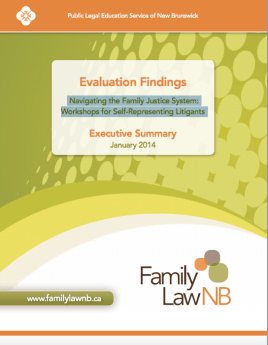
I would like to share the Findings of an Evaluation Study that was undertaken to assess the impact of family law workshops for individuals handling their own family law matters.  This initiative was developed by Public Legal Education and Information Service of New Brunswick with Access to Justice funding from the Law Foundation of Ontario.  The evaluation shows that individuals who participated in the workshop felt better prepared to complete court forms, more knowledgeable about navigating the family justice system and much less stressed.  In fact, as a result of what they learned in the workshop, 80% of participants said they were more likely to try to resolve their matter outside of the courtroom.  Court staff interviewed saw a marked improvement in the motions/petitions submitted by individuals reprepsenting themselves, although they could not necessary attribute it to the workshops. While education/information is certainly not a panacea, it can make a significant different for individuals who are dealing with”lower level” conflict situations but who do not qualify for legal aid (typically because their particular issue is an out of scope service) and they cannot afford a lawyer.  Suffice to say, we are condfident that these workshops offer an important referral source for court staff and others, and thus, a valuable adjunct service to other legal services such as legal aid. Many of the recent reports on SRLs and access to family justice have recognized the important role of providing education and information at multiple entry points.  I am attaching the Executive Summariy of the evaluation report below.

http://www.cfcj-fcjc.org/sites/default/files//321//familylaw-evaluationfindings-en-mar20.pdf