The Cost of Justice in Canada: Overview Report, Methodology and Survey

The Canadian Forum on Civil Justice (CFCJ) has released several new publications from their Cost of Justice research project, which examines the cumulative social and economic costs associated with everyday legal problems. Stemming from this project are the following recent publications:

1)   “The Everyday Legal Problems and the Costs of Justice in Canada: Overview Report”

Gathering data from over 3,000 survey respondents, the Overview Report, available on the CFCJ website here, looks at the public’s experience with the justice system and the various costs (ex: monetary, physical and emotional) that it imposes.

2)   “Design And Conduct of the Cost of Justice Survey” 

This publication sets out the specific methodology used by the CFCJ research team to collate the survey data. The method of sampling, data collection, and data processing are discussed at length here.

3)   “Everyday Legal Problems and Cost of Justice: Survey” 

The Cost of Justice Survey was structured to determine the number of respondents who had experienced 84 specific legal problems. The 84 problems were grouped into 17 types, with a section of the survey being devoted to each type. The Survey can be accessed here.

4)   “Everyday Legal Problems and the Cost of Justice in Canada: Fact Sheet”

This (updated and revised) Fact Sheet summarizes some of the key findings arising out of the Overview Report. The Fact Sheet can be accessed here.

Selected Annotated Bibliography

As part of the Cost of Justice project, The Canadian Forum on Civil Justice recently published a Selected Annotated Bibliography of some of the major national and regional legal needs surveys from 1990 to present.

This bibliography is a great resource for anyone hoping to expand their understanding of legal needs and everyday justiciable problems. To view the Selected Annotated Bibliography, visit: http://bit.ly/CFCJ-CoJBibliography

Access to Justice 101

Kathryn E. Thomson, PhD Candidate, UVic (Law), along with several AJRN listserv subscribers, have indicated publications that they would include on their “Access to Justice Top Ten Must-Read” list. There is a lot of valuable research and commentary worth revisiting or, for those of you who are new to the topic, discovering for the first time. Here are the recommendations:

  1. Genn, Hazel. Paths to Justice: What People Do and Think About Going to Law (Portland, Ore: Hart Publishing, 1999).
  2. Cromwell, Thomas A. “Access to Justice: Towards a Collaborative and Strategic Approach” (2012) 63 U.N.B.L.J. 38.
  3. Friedman, Lawrence M. “Access to Justice: Social and Historical Context” in Mauro Cappelletti and John Weiser (ed) The Florence Access-to-Justice Project (Milan: Doti.A.Giuffe Editore, 1978) Vol II, Book I.
  4. Macfarlane, Julie. “The National Self-Represented Litigants Project: Identifying and Meeting the Needs of Self-Represented Litigants” (Kingsville, Ontario: Self-Published Report, April 2013).
  5. Reports for the National Action Committee on Access to Justice in Civil and Family Matters, February 12, 2013. Online: Canadian Forum on Civil Justice: http://www.cfcj-fcjc.org/action-committee
  6. Wexler, Stephen. “Practicing Law for Poor People” (1970) 79(5) The Yale Law Journal
  7. Currie, Ab. The Legal Problems of Everyday Life: The Nature, Extent and Consequences of Justiciable Problems Experienced by Canadians (Ottawa: Department of Justice Canada, 2007)
  8. Hadfield, Gillian. “Higher Demand, Lower Supply? A comparative assessment of the legal resource landscape for ordinary Americans” (Feb. 2010) Fordham Urban Law Journal
  9. Australian Government – Productivity Committee – Access to Justice Arrangements (2014): http://www.pc.gov.au/inquiries/completed/access-justice/report
  10. McEown, Carol. “Civil Legal Needs Research Report (Report prepared for the Law Foundation of BC March 2009, 2d ed) online: Law Foundation of British Columbia: http://www.lawfoundationbc.org/wp-content/uploads/Civil-Legal-Needs-Research-FINAL.pdf
  11. Brewin, Alison & Stephens, Lindsay. Legal Aid Denied (2004): http://www.westcoastleaf.org/wp-content/uploads/2014/10/2004-REPORT-Legal-Aid-Denied-Women-and-the-Cuts-to-Legal-Services-in-BC.pdf
  12. Brewin, Alison & Govender, Kasari. Rights-Based Legal Aid (2010): http://www.westcoastleaf.org/wp-content/uploads/2014/10/2010-REPORT-Rights-Based-Legal-Aid-Rebuilding-BCs-Broken-System.pdf
  13. Track, Laura, (in collaboration with Shahnaz Rahman and Kasari Govender. Putting Justice Back on the Map (2014): http://www.westcoastleaf.org/wp-content/uploads/2014/10/2014-REPORT-Putting-Justice-Back-on-the-Map.pdf
  14. CBA Access to Justice Committee. Reaching equal justice report: an invitation to envision and act (2013): http://www.cba.org/CBA/equaljustice/secure_pdf/EqualJusticeFinalReport-eng.pdf
  15. Roderick MacDonald’s work on access to justice in Canada – a list of his words can be found here: http://people.mcgill.ca/files/roderick.macdonald/macdonald-pubs.pdf
  16. Cohl, Karen & Thomson, George. “Connecting Across Language and Distance: Linguistic and Rural Access to Legal Information and Services” (2008): http://www.lawfoundation.on.ca/wp-content/uploads/The-Connecting-Report.pdf
  17. CLEO’s Centre for Research and Innovation host a research database through the PLE Learning Exchange website. The database is an annotated bibliography of research on public legal education and information (PLEI) issues from Canada and other jurisdictions, and also contains some papers on A2J generally where PLEI is referenced: http://www.plelearningexchange.ca/research/research-database/
  18. Action Committee on Access to Justice in Civil and Family Matters. “Access to Civil & Family Justice: A Roadmap for Change” (2013): http://www.cfcj-fcjc.org/sites/default/files/docs/2013/AC_Report_English_Final.pdf
  19. The National Self-Represented Litigants Project blog by Professor Julie Macfarlane houses many A2J articles: http://representingyourselfcanada.com/

Please note that this list isn’t exhaustive and additional suggestions are welcome. What publications would you include on your “Top Ten” list?

Send an email to communications@cfcj-fcjc.org with “AJRN subscribe” in the subject line to join the conversation taking place on the listserv!

Action Committee Meeting of Provincial and Territorial Access to Justice Groups

On March 13, 2015 the Action Committee on Access to Justice in Civil and Family Matters (the Action Committee) convened a meeting for existing provincial and territorial access to justice groups (P/T A2J groups), many of which were formed in response to recommendation 5.1 of the Action Committee’s Roadmap Report.

The purpose of the meeting was to reflect on the progress made by these groups over the past year, discuss the access to justice initiatives underway in different jurisdictions, highlight promising developments, learn from common challenges, and consider collaborations and cooperation among justice stakeholders that could be further supported by the Action Committee.
The report can be accessed in English here and in French here.

Semple Explores Civil Justice Costs for Canadians

Screen Shot 2015-06-23 at 10.53.32 AM

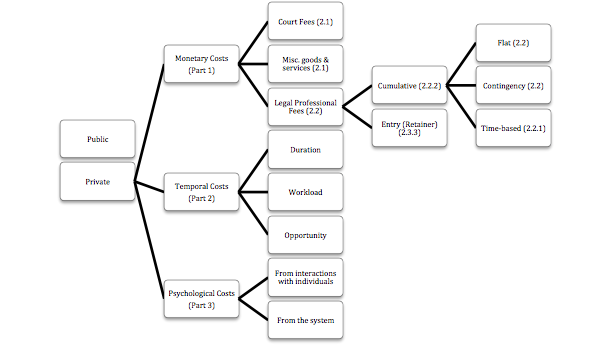
Noel Semple has recently released a paper contributing to the ongoing discussion surrounding the cost of civil justice in Canada. He draws attention to the financially burdensome nature of civil justice claims, as well as temporal and psychological costs involved with legal disputes. His thorough investigation of the issue draws on the National Self Represented Litigants Project for quantitative information about the true costs of accessing civil justice. The paper is available on SSRN.

Poverty Law, the Future of Legal Services and Access to Justice: Towards ABS+

Journal of Poverty Law

Should Alternative Business Structures (ABS) be able to dispense legal services? That question is the basis of an ongoing regulatory debate that has at its root access to justice issues and how they might be affected by a change in Canadian law towards a less prohibitive model. In the attached paper, “Poverty Law, the Future of Legal Services and Access to Justice: Towards ABS+,” David Wiseman explores this and other pertinent questions.


CLEO Paper Links Health Literacy and Legal Capability

A recent paper has been published by CLEO’s Centre for Research and Innovation on legal capability, social determinants and access to justice for vulnerable Ontarians and Canadians titled: Don’t Smoke, Don’t be Poor, Read Before Signing: Linking Health Literacy and Legal Capability.

The paper provides an overview of health literacy information practices in Ontario to give PLE organizations and related stakeholders information about effective health information practices that can be adapted to improve the accessibility, usefulness, and reach of public legal education and information.

Visit CLEO’s blog, or click here to view the paper.