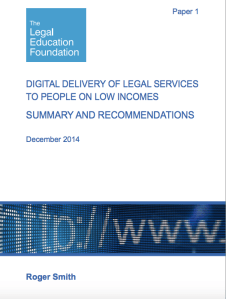
Digital Delivery of Legal Services to People on Low Incomes

The Canadian Forum on Civil Justice

Wonderful work from the The Legal Education Foundation.

“We are very pleased to have commissioned this Report from Roger Smith. We hope that the Report will stimulate others to let us know of advances that they are making or are aware of others making in this important area of using information technology to provide low cost legal service to people. These developments are not a magic bullet but taken together they can make a difference to the lives of a lot of people. We intend to update the Report on an annual basis as a record of developments in the provision of IT based legal service.”

Guy Beringer
Chairman of Governors

http://www.thelegaleducationfoundation.org/digital-report

Access to Justice Advocate – Dianne Wintermute

The Canadian Forum on Civil Justice

We are excited to announce our new blog series Access to Justice Advocates! The series is a response to recent reports that have underscored the importance of innovation and imagination in the pursuit of access to justice. At the Canadian Forum on Civil Justice, we understand that such efforts come down to people – to the diverse advocates working in different and important ways across the access to justice landscape. Our first Advocate is Dianne Wintermute, Staff Lawyer at the ARCH Disability Law Centre. Check out her interview and profile here http://lnkd.in/eA2PWSsless

Data Collection Completed for “Cost of Justice” Project

The Canadian Forum on Civil Justice

We have completed the data collection stages for our Cost of Justice national survey project! Here are some of our initial findings: – Over 35% of people reported stress, health, family and/or social issues as a result of experiencing legal problems. – Over a three-year period over 50% of adults reported experiencing one or more legal problems. – The most common problems were related to consumer, debt, and employment issues. Read more: http://obiter-dicta.ca/2014/10/14/data-collection-completed-for-cost-of-justice-project/

When Access Isn’t Enough: Examining the Intersection Between Social Inequality and Access to Justice

The Canadian Forum on Civil Justice

Blog post from Kimberley Byers draws from Alice Goffman’s new book On the Run: Fugitive Life in an American City and looks at the links between access to justice and social inequality.

http://www.cfcj-fcjc.org/a2jblog/when-access-isn%E2%80%99t-enough-examining-the-intersection-between-social-inequality-and-access-to

Access to Justice Co-Ordinating Committee

By: Chantel Amato

Earlier this year, several leaders in Nova Scotia’s justice and legal community launched a new collaborative effort – the Access to Justice Co-Ordinating Committee (A2JCC). Provincial Justice Minister Lena Metlege Diab and the Hon. Chief Justice Michael MacDonald are leading the initiative, acting on recommendations outlined in the Action Committee final report, Access to Civil & Family Justice: A Roadmap for Change.

The Terms of Reference for the Committee can be viewed here.

Great ERSS Example!

The Halton Community Legal Services, with funding from the Legal Aid Ontario’s Fund to Strengthen Capacity of Legal Clinics, has developed the Legal Health Check-Up Project. This initiative focuses on being proactive rather than reactive to everyday legal problems. The “check-up”, which can be accessed here, helps those living in poverty get help they need to solve their problems before litigation becomes necessary. The clinic points out that many people do not easily identify their problems as legal ones and often do not get help, which sometimes leads to other problems.

This initiative is currently moving into a preliminary phase to collect data while actively providing services. A list of participating clinics can be found here.

Ab Currie, Senior Research Fellow at the CFCJ, has written a blog post about this initiative on the A2J Blog.

New International Report on Access to Justice

The International Bar Association (IBA), in collaboration with the Bingham Centre for the Rule of Law, released a report titled International Access to Justice: Barriers and Solutions on October 21st, 2014 at the IBA’s conference in Tokyo.

This study, based on findings from 26 countries, identifies many different types of barriers, such as social and cultural barriers, institutional barriers, as well as ‘intersectional’ barriers. The report notes that although efforts to improve access to justice are significant there is still much work to be done and provides some recommendations.

To read the report click here. The report is also attached as a PDF.